
Yesterday, 28th June 2023, I had the opportunity to listen to a talk on cancer given to members of the Rotary Club of Entebbe. The talk was part of the launch activities for the preparation for the Rotary Cancer Run scheduled for 27th August 2023; and it was delivered by a female nurse. The nurse did not mince her words. She gave her talk succinctly and straight to the point. Her overall message:
“Cancer pains at later stages and because of our Ugandan poor health services seeking behaviour, of going to a healthcare facility only when we feel pain, many Ugandans are dying of curable cancer because by the time it is discovered it is too late.”
Dorothy Anguyo Ezatone, Nurse.
Nurse Dorothy thus strongly advises that we must be vigilant in ensuring early detection of cancer by:
Examining ourselves for signs of certain cancers, such as breast cancer and prostate cancer. Her demonstration of how do so was bold and got some blushing, especially when she demonstrated on herself how men should self examine for prostate cancer. She then strongly advised that as soon as we feel a suspicious hard lump in our breasts or prostrate, we should urgently have it checked out by a relevant medical professional.
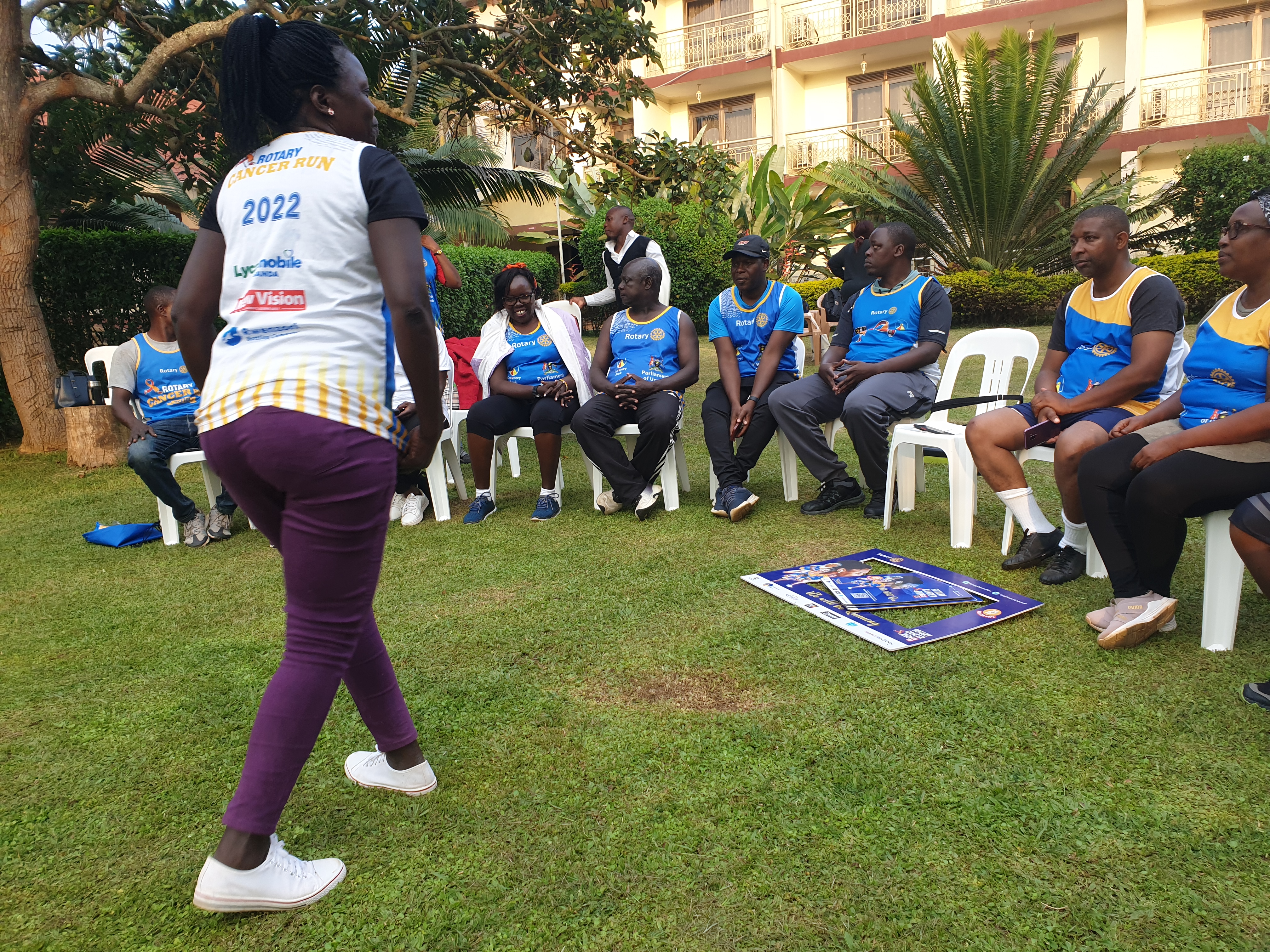 Nurse Dorothy demonstrates how men should do self-examination for prostrate cancer, during the Rotary Club of Entebbe launch of preparations for the Rotary Cancer Run scheduled for 27th August 2023.
Medical check ups by medical workers are important to be done regularly for early detection of other cancers that can only be detected through scientific testing, she advised. She urged all to take seriously cancer screening campaigns and camps; and to benefit from them.
Personal hygiene is key to avoid cancers caused by viral infections, she cautioned. And so, after her talk, I sought her out for more clarification on poor hygiene as a cause of cancer. I was particularly interested in poor hygiene related to use of menstruating pads, and so I inquired of her, if it may be a cause of cancer.
“If a woman or girl does not frequently change and refresh menstruation pads during her menstruation, she can create a good environment for viruses such as candida to thrive – that heat generated by the long stay of pads at our female genitals”
Ms. Dorothy Anguyo Ezatone, a nurse
This got me thinking about promoters of re-usable pads here in Uganda, whom I heard claiming that it is possible for a woman or girl to use their brand of re-usable pads for a whole day – as in for eight hours without the need for changing it. The promoters were only focused on how absorbent the pad is and not so much what the hygiene and health implications are for a woman or girl to keep a period-blood-loaded pad at her genitals for such a long time.
Now, a scientific study on “increased STI/UTI prevalence rates in Uganda” found that “on average, a typical Ugandan female will have an infection once a month.” I wonder to what extent women getting UTIs (urinary tract infections) every month is connected with the kind of menstruation products that they use – whether they be reusable pads or single use disposal pads.
Increasingly, even the commercial single use menstruation pads that are made of super absorbent polymer are potentially a reason for poor menstrual hygiene. This is because the absorbent nature of the pads, may seduce women or girls to find it convenient to save on buying pads, by using a pad for longer than recommended.
In fact, I know of women who testify that they encourage their daughters and they themselves not to change a pad unless it is fully soaked. This means that if they are experiencing a light flow of blood they will keep using the same pad for as long as eight hours; twice longer than recommended. This is poor menstrual hygiene and there is no doubt that it is a reason for “increased vulnerability to urinary and reproductive tract infections.”
Aside from evaluating their physical properties in terms of the absorbent index and environmental concerns, there is urgent need in Uganda to intensify empirical examination of the correlation between menstrual products and disease infections, including cancer. We need your help and support to do this. So please click here to learn more and to make a donation towards our proposed menstrual hygiene management intervention.

AND LET US CONTINUE TO ENGAGE
- Please share this post to others in your wider networks. And through comment to this post, we would love to receive feedback from you on how you and others in your network received and discussed it.
- Follow us on Twitter @CPARUGANDA; read, like, reply to and our share tweets on menstrual hygiene management.
- Follow our Facebook page; read, like comment on and share posts on menstrual hygiene management.
- Subscribe to our website; read, like, comment and share posts, such as this on menstrual hygiene management.

 CPAR Uganda
Leave a comment