
If you wink at a woman in the dark, only you know you’ve done it. So, I’m getting my act together. You must know what I am doing.
Six years ago, I encountered some young playwrights lamenting about having scripts but no actors to perform them and no venues to exhibit at. Intoxicated with theatre, I put resources together and set up the Playwrights Playhouse in Mengo.
It was a space for actors to hang out in search of playwrights. We did a great rendition of Alex Mukulu’s ’30 Years of Bananas’ as we waited for the playwrights. Our rendition was so good, it moved Mukulu to tears watching it.
 Performance of 30 years of Bananas – Photo Credit @ Philip Luswata
Fast forward, literally, into COVID-19 and we were closed for two years. Our lease run out and we couldn’t service it doing nothing. That effort fell by the wayside; music promoters were compensated for their lost shows, nobody considered promoters of theatre … story for another day.
COVID ended, night economy returned, and we jumped onto an opportunity, supported by HIVOS, to bring the traditionally NGO-Art theme of Gender Based Violence (GBV – in NGO speak) onto the mainstream commercial stage.
Without a home now, as Playwrights’ Playhouse, we thought it was time to bring back to popular commercial entertainment social themes that had been usurped from popular lore by NGO funding, to development communication – malaria, FGM, sanitation, hygiene, governance, etc.
Disclaimer: Seeing as I live in a glass house myself, I am not throwing stones, but popular commercial plays seemed to be losing social meaning for ‘indigenous’ audiences, I theorized.
So, we experimented with the musical, dance theatre piece, ‘Shame on Your Hand’. A Big man had pushed his hand up Sheebah Karungi’s skirt, but she couldn’t do anything about it, so we made theatre on it. No audience!
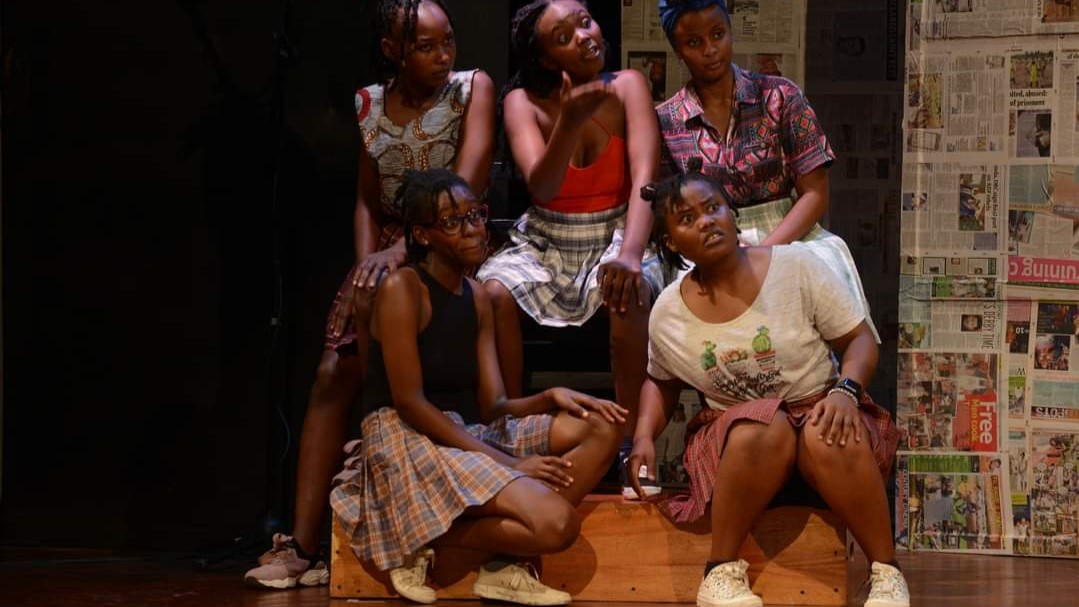 Performance of ‘Shame on you hand’ – Photo credit @ Philip Luswata
Everyone who watched it returned for a second helping, but apart from people returning, there was no audience to watch the girls who committed to tell their stories at the National Theatre. I blame you, the people.
We went back to the drawing board and pondered why there was no audience at the theatre. Then it struck me! When we enjoyed the National Theatre, Kampala City Center had a very active night economy (borrowing from Ggobi). But this economy had now shifted to the Suburbs.
Before, people used to go back home from the office, dress to the nines and return to the city to enjoy. Today, people go home from the office, throw their shorts and sandals on and walk to occupy their usual high stool spots at the neighborhood social place in Sonde, Kiwatule, Buziga, Namuwongo, Zana etc.
But theatre seems to have been left only (I avoid using ‘alone’ as that is another argument) in the city center – the National, Bat Valley, La Bonita, with the majority having dropped off (Riverside, Hollywood, Pride, Market, etc.).
My mother had closed her Nursery school after COVID, and was thinking what to do with the space. In her space I saw the opportunity to bring theatre and art practice to the suburb, where the night economy shifted.
My wife couldn’t think of it as in it she saw, not without precedent, further hemorrhaging of family money and also the idea of taking advantage of my mother’s benevolence seemed unfair.
But somehow, Wava Nursery School in Kyengera-Mugongo transformed into an open-air theater space ‘Wava Theatre’ (the boda stage is called Wava and no one could pronounce Playwrights’ Playhouse apart from me), and also a walk-in art space for the community.
My mother, who has always been my biggest fun, is now actively transforming herself into an artist; our first victory as a Centre.
Alas (my English teacher at St. Martin’s Boys Primary School in Mugoiri Murang’a loved compositions that used the word. I never thought it served any real purpose in real life, but here goes…). Alas!
 Philip Luswata at ‘roving market’ in Lango on CPAR Uganda beneficiary field visits.
Even though it is still early times, three months later, our anticipation of overwhelming community excitement for the arts expression Centre might have been a little over estimated.
We anticipated such a big public reaction to the space that we put a lot of thought in the toilets before opening … The earliest artists to the space, having seen that we received a small grant from the Braid Fund to partly cover sound and lighting, walked away as soon as they realized we were not paying for exercising passion.
So, we teamed up with some filmmakers from Kazinga (a neighboring village), led by the prolific Faridah Naluyange, to make films and theatre. The first theatre show on December 25th was graced by my family, friends, neighborhood children and some of their parents.
To give credit to the people of Mugongo, the free comedy nights on Wednesdays are well attended, but how do we create a culture of sustainable consumption of great community theatre? We are now taking a plunge.
Learning:
- What drives social media is the unending flow of new content.
- What drove sketch comedy when we started it was the promise of fresh two-hour content every week 20 years ago.
- We are now launching into a new experiment. Will audiences positively react to the commitment of a completely new full-length theatre play every weekend, throughout the 52 weekends of 2024? Is it even doable? How is it achievable? Who will watch all new 52 plays?
We have thought about the audience, now we are thinking about us. Can we do do it? We start tonight, Saturday, 6th January 2024, with a play ‘Mulamu’ by Mariam, a film maker from Kazinga. 51 to go.
Profiled photo: performance of ‘Shame on your hand’ @ Philip Luswata
This post we have extracted verbatim from our Associate Expert Volunteer Mr. Philip Luswata’s Facebook wall and republished here on our website. It is an excellent example of how an innovator should persevere and remain focused on identifying the problem and or challenges and proactively work towards finding the solution(s). Basically, do not be afraid to try. When you try and it does not go as planned, do not think of it as a complete failure. Learn from it, innovate some more and do, until you find the winning solution.

 CPAR Uganda
Leave a comment