The lyrics meaningful. The lyrics they tell a story. The lyrics they archive history for posterity. The lyrics they educate. The lyrics artistically arranged are interesting to listen to. The lyrics they are memorable for they are about lived reality.
Indigenous knowledge of ‘olusuku food system’, of oluwombo and of other Buganda cuisine, orally preserved and recorded by artists for entertainment; and serving the wider value of documenting history. Sustaining the wisdom of our ancestors for our benefit.
Our favourite artists are those whose artistic product is story telling based, where each word of the lyrics is intentional to carry a narration about daily life and cultural practices. They are the kadongo kamu artists, whose genre is referred to as “Uganda country music.”
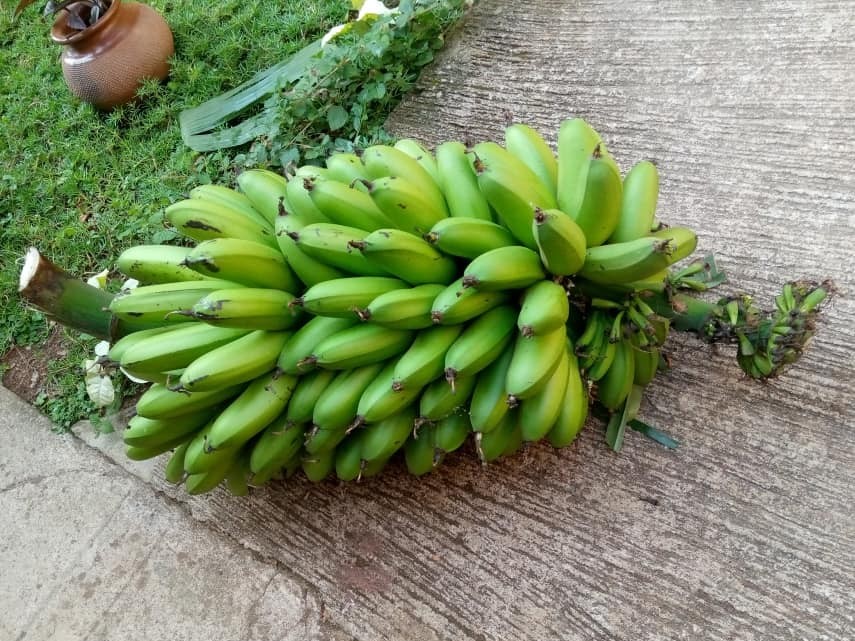
Continued significant wide practice of ‘olusuku food system’ contributes significantly to the state of food security in Buganda. “Olusuku is a mixed cropping system in which bananas, mostly the green cooking bananas, matooke, are intercropped with numerous other nutritious food crops, as well as cash crops, such as coffee.
Matooke, the staple food of Buganda, is not only a major source of nutrition, it is woven into cultural practices that ensure preservation and continuation of different varieties of matooke. There is a variety that is harvested and cooked for a visiting in-law, for gifting a newly married couple, etc.
And kadongo kamu artists make references to and explain such practices in the lyrics of their songs.
The matooke food system, indeed, ensures food security in Buganda through two major ways of accessing food – consumption of own production; and grow to sell surplus from which income is generated that enables access to food via buying.
Kudos to Buganda Kingdom for it hosts in its territory 28% of Uganda’s population, about 13 million people and, on average, in majority households, nearly 71%, that are food secure.
Continued appropriate traditional farming practices, as have been preserved and promoted by Buganda, including by kadongo kamu artists, likely contributes to the positive state of food security throughout Buganda.
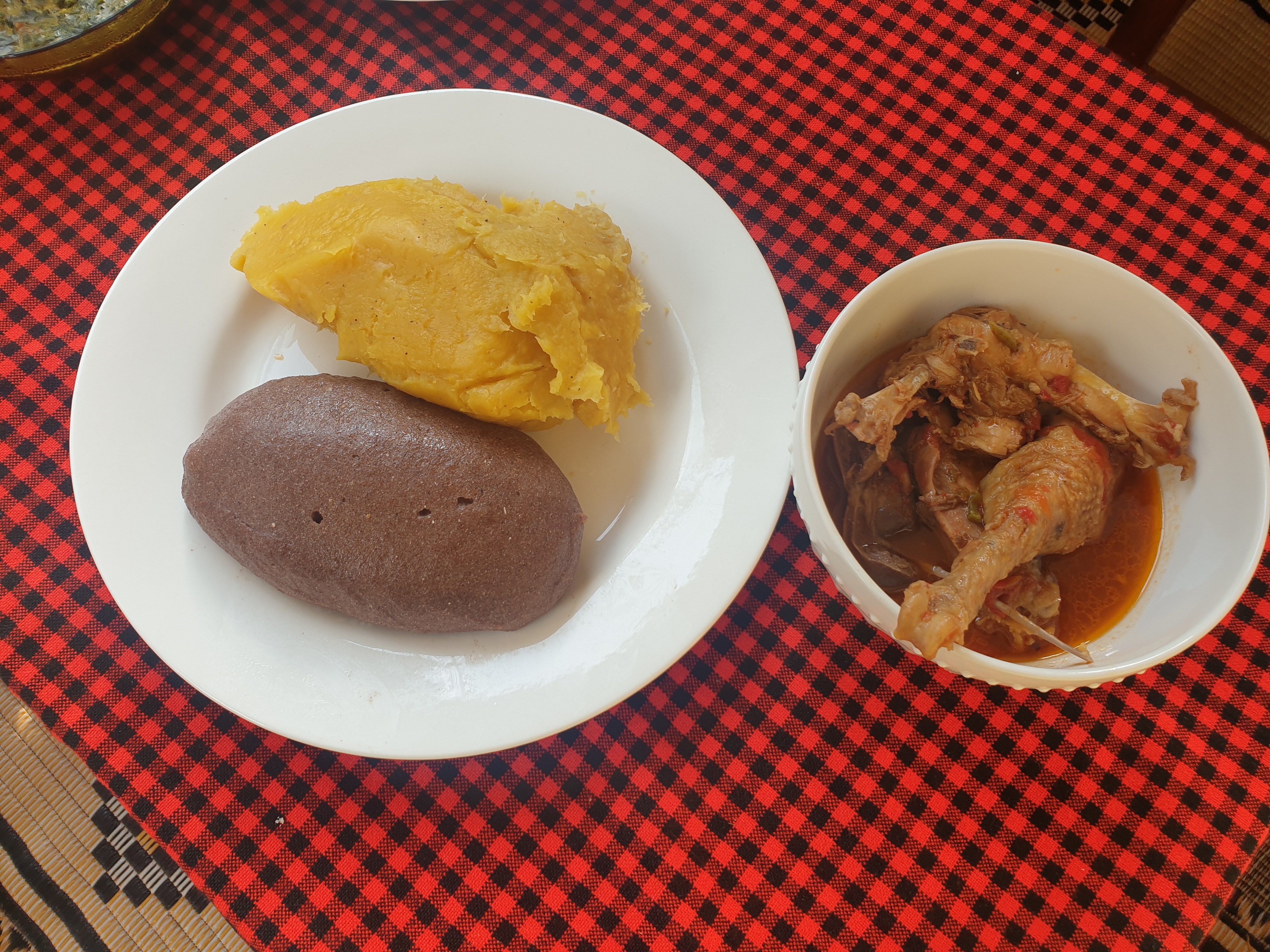 Cooked matooke turns yellow. In Buganda cuisine, matooke is steamed in banana leaves and mashed. Here paired with millet ugali and served with chicken.
In four districts of Buganda 80% and above of households are food secure:
- 84.4% of households in Gomba District are food secure.
- 81.5% of households in Bukomansimbi District are food secure.
- 81.4% of households in Ssembabule District are food secure.
- 80.0% of households in Butambla District are food secure.
In nine districts of Buganda 75% to 79% of households are food secure:
- 79.2% of households in Kalungu District are food secure.
- 78.6% of households in Lwengo District are food secure.
- 77.1% of households in Luwero District are food secure.
- 77.0% of households in Nakaseke District are food secure.
- 76.7% of households in Kyotera District are food secure.
- 75.7% of households in Kassanda District are food secure.
- 75.2% of households in Kiboga District are food secure
- 75.1% of households in Lyantonde District are food secure.
In four districts of Buganda 70% to 74% of households are food secure:
- 72.9% of households in Mpigi District are food secure.
- 72.5% of households in Mubende District are food secure.
- 71.7% of households in Kyankwanzi District are food secure.
- 70.2% of households in Masaka District are food secure.
In nine districts of Buganda less than 70% of households are food secure:
- 67.7% of households in Rakai District are food secure.
- 65.8% of households in Nakasongola District are food secure.
- 64.2% of households in Wakiso District are food secure.
- 62.8% of households in Kampala District are food secure.
- 61.4% of households in Mukono District are food secure.
- 60.4% of households in Buikwe District are food secure.
- 56.0% of households in Kayunga District are food secure.
- 48.5% of households in Kalangala District are food secure
- 43.7% of households in Buvuma District are food secure.
There are only two districts of Buganda in which minority households are food secure – Kalangala and Buvuma, which host a population of 185,243 people.
Hundreds of households in the two districts were displaced off their farmlands to make way for exogenously introduced commercial oil palm cultivation. Significantly negatively impacted their ‘lusuku food system’ and therefore their livelihoods, causing them to experience:
“Frequent and prolonged periods of insufficient food intake due to lack of money and other resources, forcing members of those households to skip meals or go an entire day without a meal.”
The state of food security in Buganda is consistent with the finding that 9.6% of persons aged 10 years and above in Buganda have “probable general psychological distress;” which is 2.4 percentage points lower than the national average, which is 12.0%; and 6.8 percentage points lower than the highest regional average, specifically of Teso, which is 16.4%.
It is baffling, therefore, the finding that the people of Buganda have a life expectancy of 63 years, fifteen years less than the highest regional life expectancy in the Country, specifically of Teso, which 78 years.
Information herein is extracted from the most recent Uganda National Population and Household Census Report, by the Uganda Bureau of Statistics. A PDF copy of the report is available to download free here.
Uganda Bureau of Statistics measures food poverty using the Food Insecurity Experience Scale.
To LEARN MORE about the work of CPAR Uganda and MAKE A DONATION click here.

 CPAR Uganda
Leave a comment