The mission of CPAR Uganda is to stimulate development, dissemination and widespread application of technologies suitable and adaptable to the social cultural and economic conditions in Uganda.
For this reason, a major component of our action is holding training courses. Mostly targeted towards youth – ages 18 to 40 years.
We do training of youth, in order to achieve all the three parts of our mission – development, dissemination and application of technologies.
This means we target beneficiaries of our training activities to be youth who will be inspired to develop, disseminate and apply their learning, as well as encourage others to adopt and or adapt suitable technologies.
We consider our training activities as gifts to youth, particularly from or resident and working in the poorest region of our country, our strategic geography of operation, the Greater Northern Uganda – West Nile, Acholi, Lango, Teso, Karamoja and Bukedi.
Gifts of training, practical knowledge and skills, that the beneficiary may utilize to improve their lot for a life time is our business. As in, we are convinced that we give gifts that keep on giving.
Case in point, we have an on-going call for applicants to our Financial Management training on “Simple Money Skills for Everyday Business,” under our “Dr. Paul Hargrave Memorial Centre Human Development Project” that we are jointly implementing with Canadian Physicians for Aid and Relief.
CLICK HERE to learn more and to Apply
It is shocking the feedback that we are getting from potential applicants asking if we are going to pay them to come for the training. Asking if we are going to pay them sitting and/or training allowances; and if we are going to cover their transport costs to and from the training.
We despair!
Ordinarily, in Uganda, when parents, guardians and or sponsors take their learners to school, they pay school fees, buy all the requisite training materials and upkeep items and transport their learners to school.
Why is it that when a nonprofit is offering to cover all costs of training, it is found okay to ask tor training allowances?
How is it that learners to the formal education system and for-profit institutions cover their own transport costs, but expect a nonprofit to cover their transports costs to a training in which no other costs are being requested from the learner?
This is where we work, Uganda, where untenable participant expectations to receive a substantial allowance for any type of training, workshop and or meeting widely prevail. To the extent that allowances to participants are prioritized over and above the purpose of the activity.
How did we get here?
In principle, we, at CPAR Uganda, are resolved that a beneficiary who does not make any financial investment in accessing our training activity, will likely not voluntarily and freely share learning with and for the benefit of our ultimate target – wider communities of our strategic area of operation.
And so, for all our training courses, the very minimum that we require is that the participants must cover their own transport to and from our centers where we hold residential training.
How can we ensure and assure that such persons, change agents, who will return to their respective communities to do the greater good are aware of our calls for applicants, apply and benefit from our training activity?
We are open to and welcome your advice.
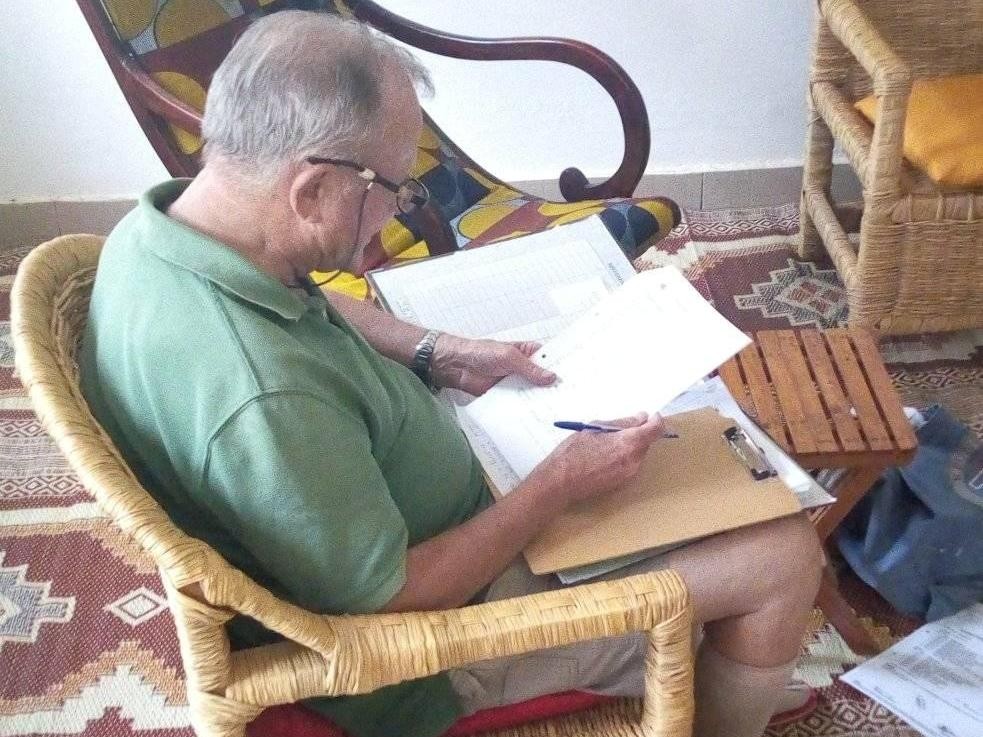
Profiled photo @ Stan Burkey (RIP) our volunteer advisor reviewing applications to our successful Mentoring Young Adults into Innovators Against Poverty Project.
 CPAR Uganda
Leave a comment