
Our Dr. Paul Hargrave Memorial Centre Human Development Project, co-implemented with Canadian Physicians for Aid and Relief (CPAR), affords us with an opportunity to hid the call that is the theme of World TB Day 2026:
“Yes! We Can End TB! Led by Countries. Powered by People.”
Our intention is consistent with our, CPAR Uganda mission to stimulate development, dissemination and widespread application of technologies suitable for Uganda.
CLICK HERE to read “Data needed to fight TB” and learn more about our theory of change for contributing to the fight against TB.
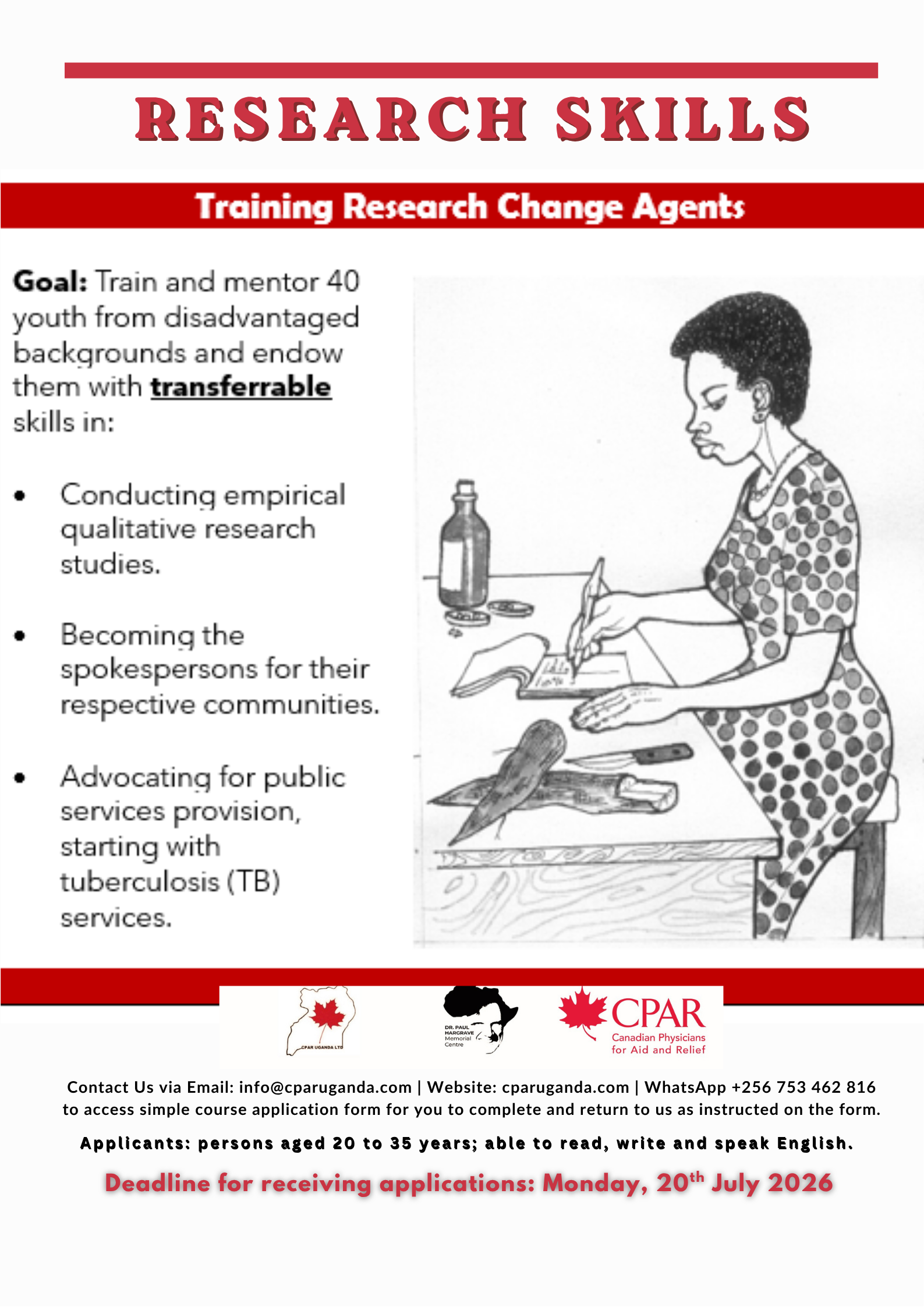
Using the case of tuberculosis (TB), it is our intention and plan, together with CPAR, to train and mentor 40 youth from disadvantaged backgrounds into Research Change Agents.
Endowing youth with transferrable life skills that will enable them to: “apply academia for the public good – translating research and scholarship into actionable solutions that address societal challenges.”
And to “bridge the gap between theoretical study and real-world impact through community-engaged research, policy advocacy, and technology transfer.”
Our training of research change agents will be delivered as a masterclass, in a highly participatory manner; while using real life examples.
The course content for the masterclass includes: study design, data collection, data analysis, writing, publication, and innovative dissemination of empirical study findings.
Details on how to apply are in the poster below:
The Context
I sincerely hope not, but it is highly likely, a significant part of an important recent headline, “his team complain of exposure to TB,” case in point, has largely gone without due appreciation from the wider general public.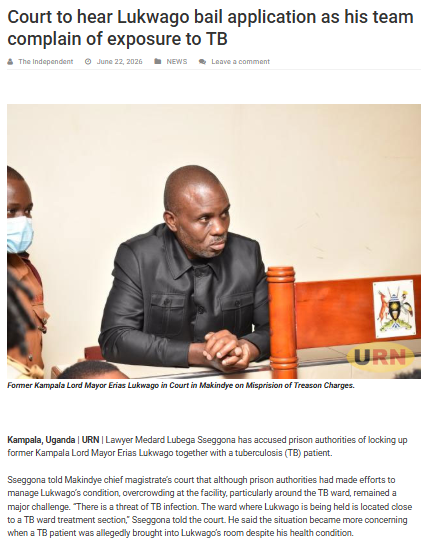 CLICK HERE to read the full story, “Court to hear Lukwago bail application as his team complain of exposure to TB,” as published in The Independent.
A major method of TB prevention is to isolate those who are infected and to urgently put them on the requisite treatment.
Allegations, therefore, that Kampala Capital City Lord Mayor Emeritus Erias Lukwago was exposed to TB by prison authorities should ordinarily concern us all.
Those allegations, in fact, should have activated specific strands of public discourse focused on TB. Certainly, from a rights and a public health perspective; and others.
TB is a preventable airborne disease.
However, “in Uganda, the situation is alarming, with an estimated 96,000 people falling ill with TB annually.” This is according to World Health Organisation (WHO), in a communique titled: “World Tuberculosis Day 2025: Uniting to End TB in Uganda.”
Yes, TB is curable, especially so, if treatment is timely.
Nevertheless, some damage caused by TB is irreversible, including death.
“PTB (pulmonary TB) survivors experience post high mortality rates after TB cure. Survivors who were hospitalized and unemployed at treatment initiation were more likely to die after cure.”
The quote above is among empirical research findings published in the International Journal of Infectious Diseases, in an article by Baluku et al. titled: “Death after cure: mortality among pulmonary tuberculosis survivors in rural Uganda.”
WHO data for 2021 indicates TB is number four among the top diseases that cause death among the male population in Uganda; and number six among the top disease that cause death among the female population in Uganda.
Uganda is known for its dexterity in responding to pandemics, Covid-19 and Ebola, case in point. Which begs the questions:
Why then does a preventable and curable infectious disease, TB, not get the same level of urgency and attention for eradication from our Country? Or does it?
How come TB continues to sustain in Uganda; killing Ugandans in the thousands annually?
The intent of the Research Change Agents training masterclass, is to nurture youth to take interest in genuine and well informed civic activism for the greater public good.


Leave a Reply