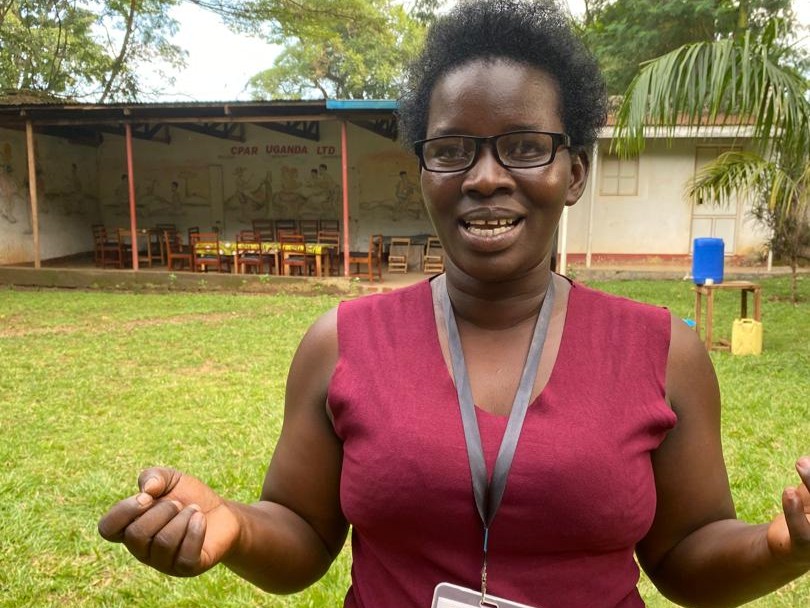
“They are pretty and give me the ability to see the world. With eyesight, I am able to cook all my meals for myself. My favorite food to cook are cowpeas leaves. Eating cowpeas leaves is very good for health. Cowpeas leaves are very good in supporting good health for pregnant women, digestion, and help manage blood sugar levels. That is why doctors have been known to instruct patients to eat greens. When our grandmother was still alive, she used to tell us about the story of where we originated. According to her, we are the descendants of Iteso. And it is from her Iteso heritage that she taught us about cowpeas leaves and their nutritional importance. I am happy I have eyes, was able to see and have memories of my grandmother. And so, yes, my favorite thing about myself are my eyes. I am a Ugandan, born in 1996. I am a Lango by tribe, by the name Akello. My name is my heritage. It was my grandmother’s name too.”
The CPAR Participatory Action Research Writing Masterclass is in session. The first topic of the class is:
“Fact-based storytelling that is based on community-held knowledge.”
To put into practice theoretical lessons of the importance of all writers being familiar with the five Ws (who, what, where, when, why) and H (how), participants were asked to write in answer to the question:
“What is your favorite thing about yourself?”
It is in this context that Akello wrote about her eyes, as her favorite thing about herself.
Reading Akello’s story got me thinking about our CPAR Uganda “Restore eyesight and worth of rural poor in Uganda” project.
Millions in Uganda are visually impaired and thousands are blind.
Moreover, “according to Ministry of Health, 57 percent of blindness cases in Uganda are due to cataracts, a condition that can be treated (source CPAR Uganda).”
And so, we, at CPAR Uganda, are making a contribution through advocacy that may lead to provision of eyecare services to those who need them the most and are unable to afford them.
Case in point, a cataract kit that is needed to perform cataract surgery on one patient costs about Shs. 600,000 (six hundred thousand shillings).
Whereas, cataract sufferers may benefit from free surgery at Government hospitals, many would have to travel far, in order to access services.
Reality is that Uganda has very few eye doctors.
Case in point, for the whole of Karamoja region, hosting about three million people, there is only one eye doctor located in Moroto Regional Referral Hospital.
Government notoriously under prioritizes and underfunds eye care health services, consequently denying millions the ability to be fully functional humans. And to be like Akello,
Functional humans able to lead a good quality of life for them and their households, unimpeded by visual impairment.
It is our hope that beneficiaries of CPAR Uganda, CPAR trained change agents, will proactively engage in contributing to bettering quality of lives in their respective communities, including advocating for eye care services provision.
Profiled photo @ Akello at the CPAR Uganda Dr. Paul Hargrave Memorial Centre, where she is participating in the CPAR Participatory Action Research Writing Masterclass, under the Training of Research Change Agents component of the Dr. Paul Hargrave Memorial Centre Human Development Project, jointly implemented by CPAR Uganda and Canadian Physicians for Aid and Relief (CPAR).


Leave a Reply