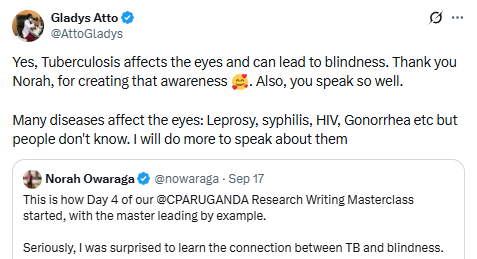
 “Yes, tuberculosis affects the eyes and can lead to blindness. Thank you, Norah for creating that awareness. Also, you speak so well. Many diseases affect the eyes: Leprosy, syphilis, HIV, Gonorrhea etc., but people don’t know. I will do more to speak about them.” Dr. Atto.
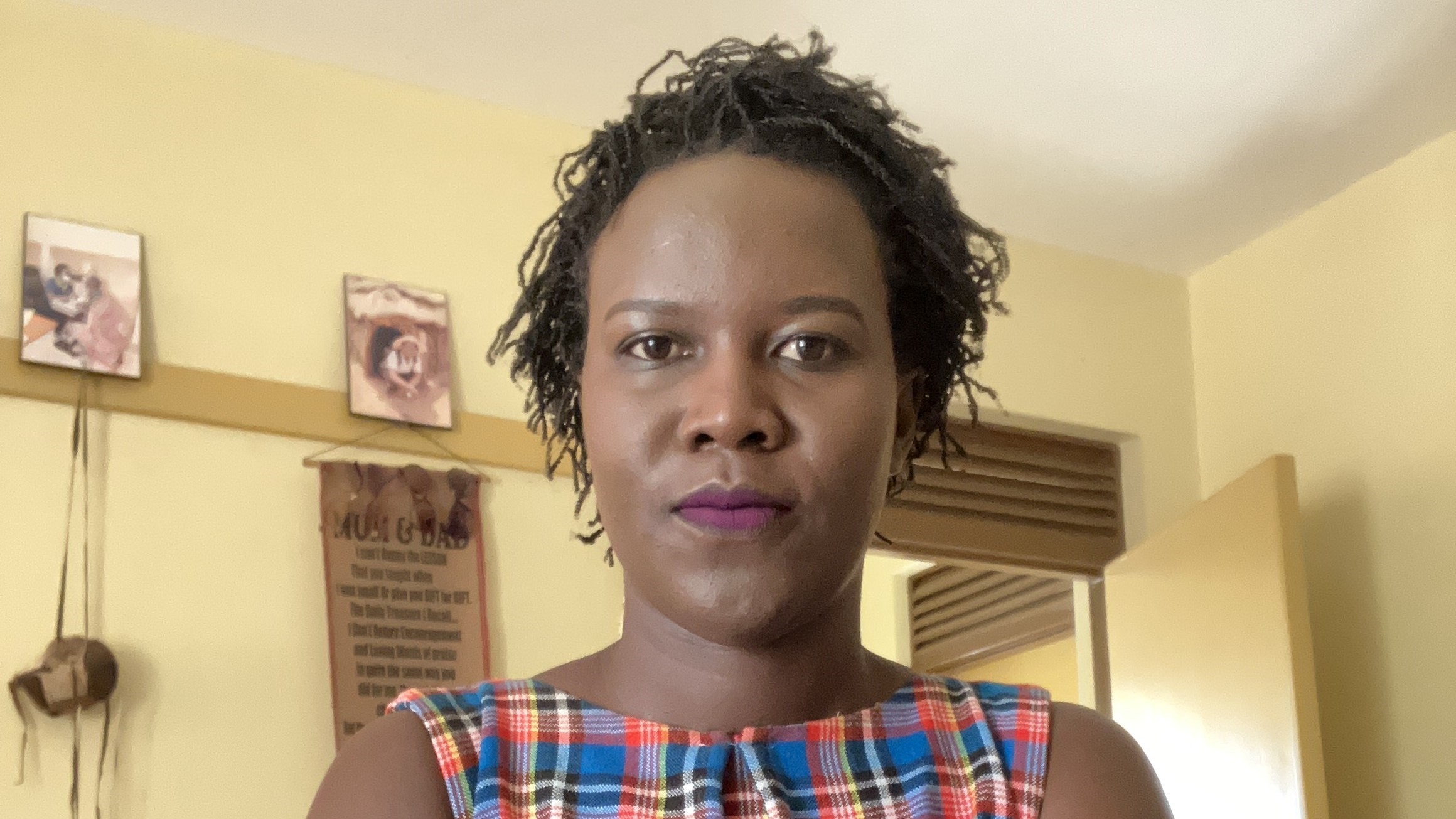
 Dr. Atto is an award winning ophthalmologist, among only 40-60 specialists eye doctors in Uganda. She is based at Moroto Regional Referral Hospital, serving the whole of Karamoja Region, an estimated over two million people.
Dr. Atto wrote on X in response to my X-video-post in which I expressed my surprise at learning that there is a connection between tuberculosis and blindness.
I did also share the same video on TikTok and, as of today, 20th September, it had got over 2,150 views and over 820 likes. In addition, over 25 saved it as among their favorite to come back to.
In the video I said:
“I was very shocked to find out that people can lose their eyesight by tuberculosis. I always thought that tuberculosis is a disease that affects the lungs. But, I found out that the same bacteria that causes tuberculosis can cause blindness or visually impair somebody. And worse more, not only does the bacteria that causes tuberculosis cause eye failure, the treatment that is used to treat tuberculosis can actually cause somebody to lose their eyesight. Am thinking, how many people know this? Am thinking, do our leaders know this? I did a Google-search and I never found any links leading to our authorities explaining to us. Nothing from Ministry of Health. Nothing from anybody saying: “In Uganda people may be losing their eyesight, because of tuberculosis.”
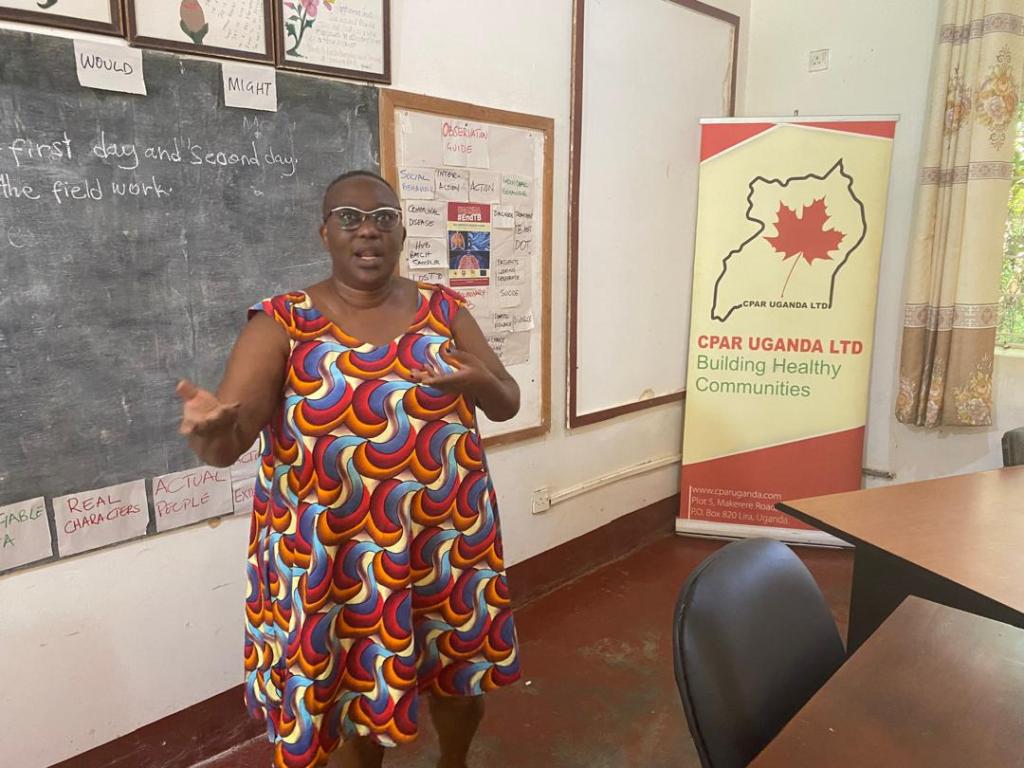
I made the two-minute video as an example for our CPAR Uganda Participatory Action Research Writing Masterclass, currently ongoing (13th to 26th September 2026).
It is an example to demonstrate fact-based storytelling, based on community-held knowledge, and the skill of authoring fact-based and action-oriented publications.
I intended it to inspire learners to utilize the opportunity of online publications, specifically social media, for amplifying grassroots voices of vulnerable and disadvantaged communities.
In the video, I focused on visual impairment and tuberculosis, both neglected afflictions in Uganda, in terms of public services provision.
Consequently, indigent persons and households in Uganda who are unfortunate to be afflicted with visual impairment and or tuberculosis live undignified lives, during which their rights are violated.
CPAR Uganda’s theory of change is that once skilled in storytelling and action-oriented writing, our beneficiaries, Research Change Agents, on return to their respective communities, will utilize skills learned for the greater good.
- Seek out and amplify voices of vulnerable and disadvantaged communities.
- Bring to public and policy making arena realities of the quality of life lived by rights holders.
- Purposefully, with facts, influence duty bearers to make and implement effective policies.
At our CPAR Uganda Dr. Paul Hargrave Memorial Centre in Lira City, 10 youth (6 women and 4 men) are in training to become Research Change Agents.
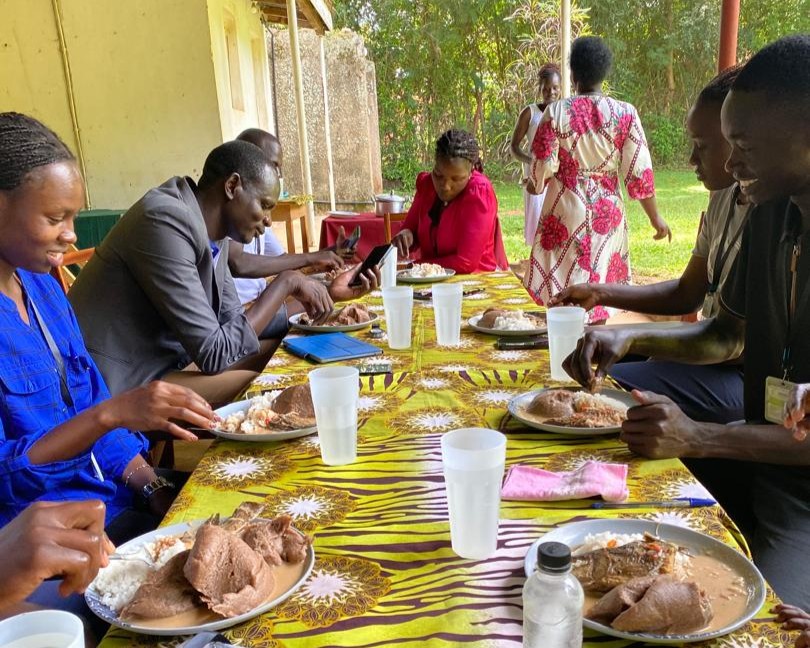 Research Change Agents in training, Participatory Action Research Writing Masterclass, enjoy Friday lunch, at our CPAR Uganda Dr. Paul Hargrave Memorial Centre in Lira City.
They are beneficiaries of our Dr. Paul Hargrave Memorial Centre Human Development Project, jointly implemented by CPAR Uganda and Canadian Physicians for Aid and Relief.
Benefiting youth are from Acholi sub-region, Lango sub-region, Teso sub-region and Karamoja sub-region, all of the Greater Northern Region of Uganda, our CPAR Uganda geographic area of operation.
Through proactive advocacy of our beneficiaries, Change Agents, we, at CPAR Uganda, are confident that we will contribute to the reduction of those who get afflicted with visual impairment.
And, as well, contribute to increasing health services provision.
We are grateful to all our funding partners for their financial contributions.
Contributions without which we would not be able to equip youth with life skills and to stimulate change processes that will lead to health service provision for persons and households afflicted and affected by visual impairment.
Please help us to spread the word about our work. For more information and to make a donation we invite you to visit our GlobalGiving Project Profile, “Restore eyesight & worth of rural poor in Uganda” – simply click here.


Leave a Reply